ClubCards – Loyalty card app
ClubCards – Reinventing Loyalty, Without the Noise
Overview
ClubCards started with a moment of everyday frustration. At the supermarket, my wife tried to open her loyalty app — but after a recent acquisition by Klarna, Stocard had turned into a cluttered, ad-filled experience. It took four taps, two banners, and an internet connection just to scan a card. That’s when the idea was born: what if a loyalty app was stripped back to what people actually needed — instant access, offline reliability, zero noise.
ClubCards became my exploration into designing for purity, privacy, and performance — a frictionless tool that respects user time and attention.
Challenge
Most loyalty apps are designed for the business, not the user. They push campaigns, collect data, and bury the one function that matters — showing the barcode. The challenge was to reverse that logic: create a product that’s fast, private, and functional even without a connection.
Three core pain points defined the problem:
- Too many steps: Users needed multiple taps to reach their cards.
- Internet dependency: Most stores (especially supermarkets in new neighborhoods) have poor mobile reception.
- Trust erosion: People stopped using the app because it felt like surveillance, not convenience.
Solution
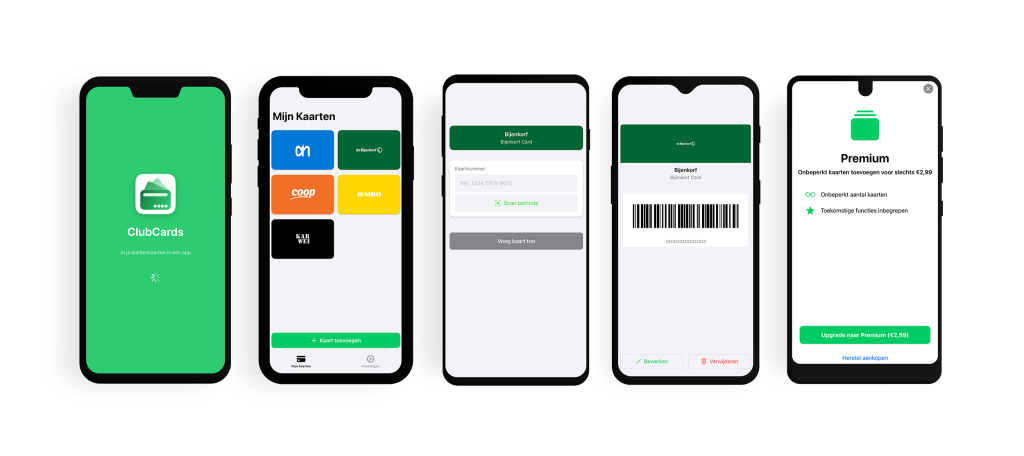
I designed ClubCards as a zero-friction digital wallet for loyalty cards. No login, no ads, no tracking — just clean UX and offline-first technology. Each feature was guided by one rule: one gesture, one action.
UX Design:
A minimal UI with only two layers: the card list and the scanner.
Animations were kept subtle to emphasize speed and clarity.
High-contrast design for quick legibility at checkout.
Engineering Approach:
Built as a Progressive Web App prototype in Cursor, combining Figma design with live code iteration.
The system stores card data locally (using browser storage) for instant offline access.
Barcode rendering happens client-side — meaning the app works even in airplane mode.
Monetization Model:
To keep ClubCards ad-free, I introduced a one-time Premium upgrade for €2.99. The decision wasn’t commercial — it was UX-driven.
By creating a lightweight paywall for unlimited cards, the app filters out spam users while preserving privacy and simplicity for real ones.
This small, transparent fee aligns with the brand principle: no tracking, no upselling, just pure utility.
Privacy Principle:
No analytics, no profile creation, no backend logging.
It’s a digital tool, not a data pipeline.
Results
- Access time reduced from 10s → 2s (measured across prototypes)
- 100% offline availability — cards load instantly, even without internet
- Zero ads, zero tracking, 100% user focus
- Early testers described it as “the first loyalty app that respects me.”
ClubCards redefines what “smart convenience” means — proving that the best user experience is often the one that disappears.
Key Insights
- Frustration is the best research trigger. Great ideas often start when something feels just a bit too annoying.
- Privacy is a feature. By not asking for data, you create trust faster than any loyalty program could.
- Offline-first is underrated. True reliability comes from designing for the edge cases — the checkout line, bad Wi-Fi, and everyday real-world chaos.