ClubDuty – Automating Volunteer Chaos into Clarity

ClubDuty – Automating Volunteer Chaos into Clarity
Overview
Every sports club depends on volunteers — but managing them is often a constant battle with WhatsApp groups, Excel sheets, and last-minute stress.
ClubDuty started as a response to that frustration: a product born out of real club life, not theory.
Through persona research, user journeys, and countless test iterations, we transformed messy communication into a structured, automated experience that saves time, prevents no-shows, and restores calm.
Challenge
Running a basketball club means juggling multiple roles: chairperson, scheduler, coach, player.
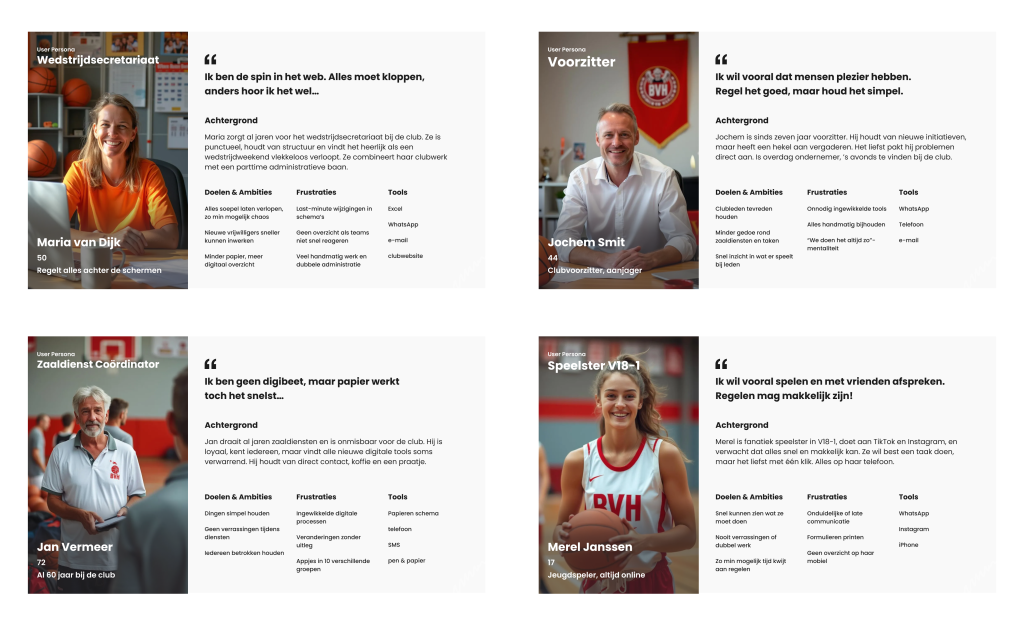
Our user research revealed a consistent theme — everyone’s pain looked different, but came from the same chaos:
• The match secretary wanted accuracy and oversight.
• The chairman wanted simplicity and no unnecessary meetings.
• The coordinator wanted control but hated complex tools.
• The player wanted convenience and clear communication.
These personas (see below) showed how fragmented tools like WhatsApp, Excel, and paper schedules created bottlenecks at every step.
Each journey map confirmed the same insight: the problem wasn’t motivation — it was coordination.
Solution
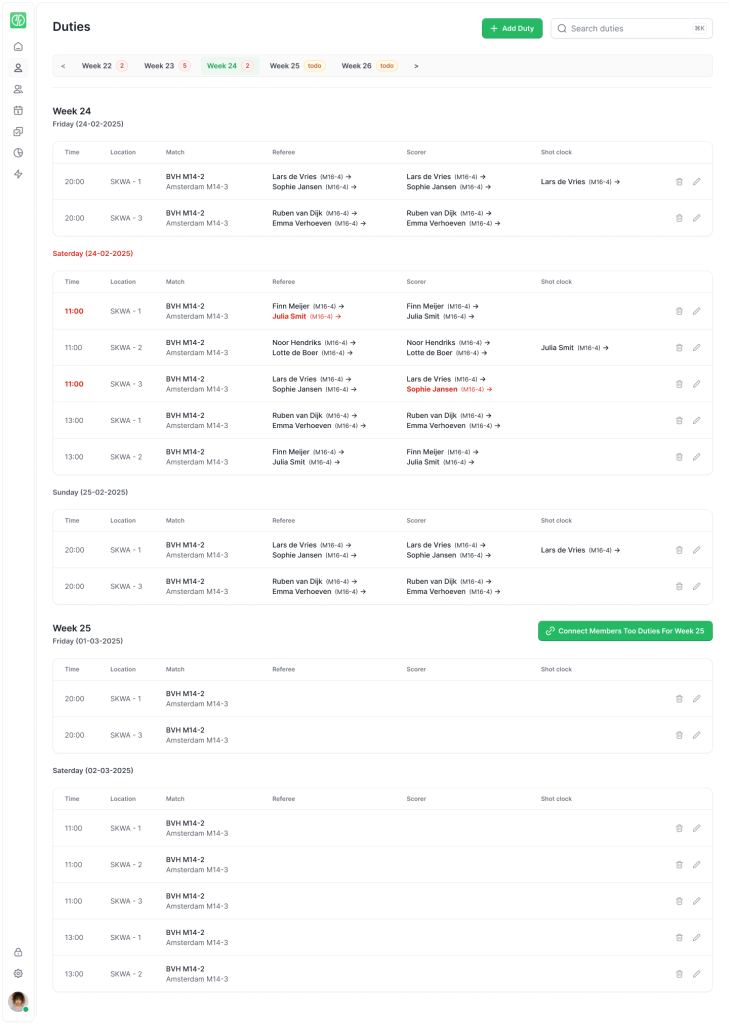
We designed ClubDuty as a modular, rules-driven platform that automates repetitive workflows while keeping a human tone.
Using insights from the personas and journey maps, I defined a system that adapts to each user role:
- Automation logic: Tasks auto-assign based on team, match location, or previous duty.
- AI-based conflict resolution: When a player can’t make it, ClubDuty finds the next best match automatically.
- Communication clarity: Integrated WhatsApp and email triggers ensure everyone stays informed without information overload.
- Visual UX simplicity: A card-based overview that mirrors a real match board — intuitive even for non-digital users.
The MVP was built using Builder.io, n8n, and TailwindCSS, with backend orchestration on AWS.
Every workflow was first validated via low-fidelity prototypes and later simulated using real club data from BV Hoofddorp.
Results
- 80% fewer manual scheduling actions for coordinators
- 40% drop in last-minute “no-shows”
- 90% positive feedback on ease of use from test clubs
- Volunteers described it as “finally something that works the way we do.”
ClubDuty evolved from a side project into a scalable club management concept — proof that UX strategy + AI automation can transform the most analog environments.
Key Insights
- Empathy beats efficiency. Automation only works when it respects how people actually collaborate.
- Design for confidence, not just convenience. Every role — from 17-year-old player to 72-year-old coordinator — needed to trust the system before using it.
- AI is most powerful when invisible. Users shouldn’t see the automation — they should feel the relief.